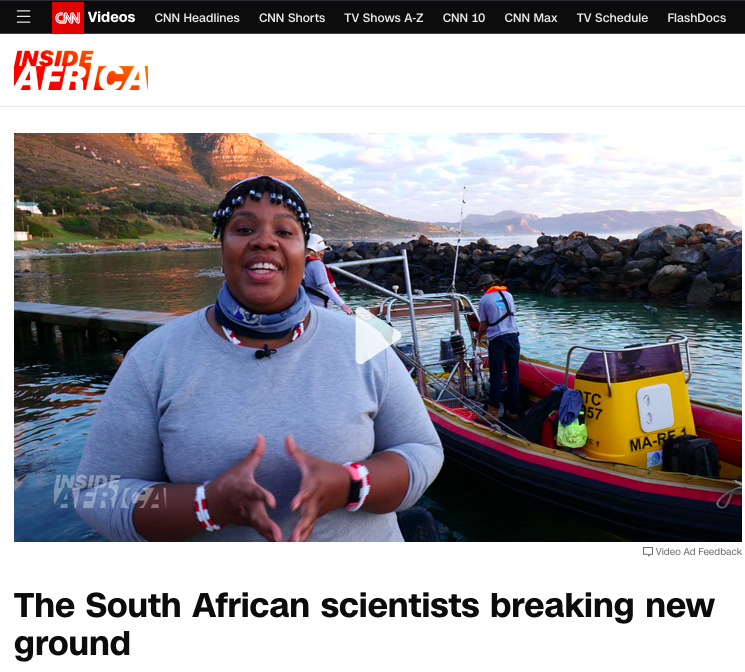
During my PhD, as I was deep in research, I was contacted by CNN producers who were referred to me by my late friend and colleague, Ndoni Mchunu. I had the incredible honour of being featured on CNN Inside Africa in a segment highlighting South African scientists breaking new ground. It was a surreal moment that brought together years of dedication, countless hours in the lab, and a passion for ocean science that has shaped my career and life.
The CNN feature was part of their Inside Africa program, which focused on women in STEM and the pioneering work happening across the continent. For me, it was a unique opportunity to share my research and stand alongside other brilliant scientists making waves in fields like oceanography, environmental science, and archaeology.
The Importance of Representation
Being a part of this feature was more than just a spotlight on my research; it was a powerful statement about the role of African scientists, particularly women, in shaping global scientific knowledge. Growing up, I didn’t see many people who looked like me in the spaces I aspired to be in—let alone on global platforms like CNN. Having the chance to share my journey with the world was a reminder of why representation matters. I’m committed to showing young African women and girls that they, too, can excel in STEM fields.
My PhD and Ocean Science Research
At the time of the CNN feature, I was deep in data analysis and writing my PhD research and papers on the discoveries I made. My PhD work, which I submitted in 2023, focused on ocean science, with a particular emphasis on understanding how our oceans are changing in the face of climate change and how they make planet Earth habitable. South Africa’s unique position as a coastal nation gave me the perfect platform to explore critical issues that not only affect our local marine environments but also have broader implications for global ocean health.
The feature allowed me to discuss the significance of my research and how we, as African scientists, can contribute valuable insights to international scientific discussions. I showcased my work on understanding oceanic shifts and their impact on marine microbial communities and human communities. Communicating my study on such a large stage was a true milestone in my academic career.
Breaking New Ground
The title of the feature—South African Scientists Breaking New Ground—was especially meaningful to me. It captured the essence of what it means to push boundaries in a space that historically hasn’t had much African representation. It also reflected the dynamic nature of scientific discovery—how new knowledge can shape the world and create a brighter future for all.
This experience reaffirmed my belief that science communication is as important as the science itself. Sharing the beauty and importance of our work with the world opens doors for future collaborations and inspires the next generation to think critically and act boldly.
Looking Forward
Now that I’ve completed my PhD and reflected on my journey, I realize how significant moments like this CNN feature are. They show that African scientists, especially women, are participating in cutting-edge research and leading in critical areas that affect our planet.
I am deeply grateful and forever inspired to keep pushing forward and to continue my work in ocean science, science communication, and research education through my company, Ulwazi.
To watch the full CNN feature, you can check it out here.
Here’s to breaking more ground!
Dr Kolisa Yola Sinyanya
4o
 Dr Kolisa Yola Sinyanya