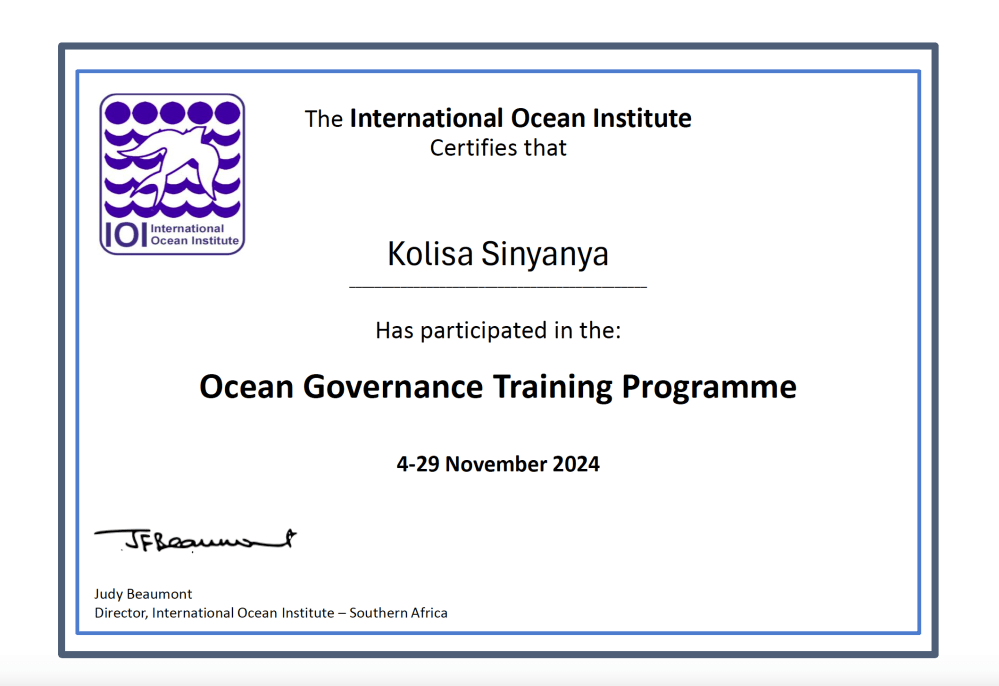
The ocean is the beating heart of our planet, connecting nations, cultures, and ecosystems. As someone deeply invested in ocean biogeochemistry and sustainable development, I’ve always believed that science and policy must work hand in hand to ensure the health and longevity of our marine environments. This conviction led me to take part in the International Ocean Institute (IOI) Ocean Governance Training, a transformative experience that has reshaped my perspective on ocean stewardship.

Bridging Science and Policy
The IOI training brought together an incredible cohort of professionals from diverse fields; scientists, policymakers, lawyers, and environmental advocates; all united by a shared passion for the ocean. This diversity fostered rich discussions about global ocean challenges, from overfishing and climate change to the complex geopolitics of maritime boundaries.
As a scientist, my world often revolves around data, experiments, and environmental models. This training expanded my understanding of the legal, economic, and social frameworks that govern how we interact with the ocean. Topics like the United Nations Convention on the Law of the Sea (UNCLOS), marine spatial planning, and sustainable blue economies illuminated how my research will inform and be informed by these governance structures.
Learning Through Collaboration
One of the most impactful aspects of the program was the collaborative environment. Group exercises simulated real-world challenges, such as negotiating international agreements or designing and managing marine spatial planning. These activities underscored the importance of interdisciplinary approaches to ocean governance.


I found myself reflecting on how my work as a researcher and science communicator could help bridge gaps between stakeholders. Scientific data, when communicated effectively, can be a powerful tool for influencing policy and empowering coastal communities.
Key Takeaways
- Holistic Perspectives: Ocean governance requires integrating science, policy, law, and community perspectives. No single discipline can address the complexities of marine conservation and management.
- The Power of Communication: Clear, impactful communication is critical for translating science into actionable policy. This aligns closely with my work at Ulwazi Scientific Communications, where we strive to make scientific knowledge accessible and relevant.
- The Need for Representation: The voices of African nations and other underrepresented regions are vital in global ocean governance discussions. We must ensure equitable participation in decision-making processes that affect our shared marine resources.
A Call to Action
As I reflect on this enriching journey, I am reminded of the responsibility we all share in safeguarding our oceans. Whether through research, education, or policy, each of us has a role to play in fostering a sustainable relationship with the sea.
For me, the IOI training has deepened my commitment to combining scientific insight with governance strategies to support thriving marine ecosystems and resilient coastal communities.
To my fellow ocean advocates: let’s continue to build bridges between disciplines, regions, and cultures. Together, we can navigate toward a sustainable future for our oceans.
Dr. Kolisa Yola Sinyanya
Founder and Director, Ulwazi Scientific Communications and STEM Research
 Dr Kolisa Yola Sinyanya