A Necessary African Conversation
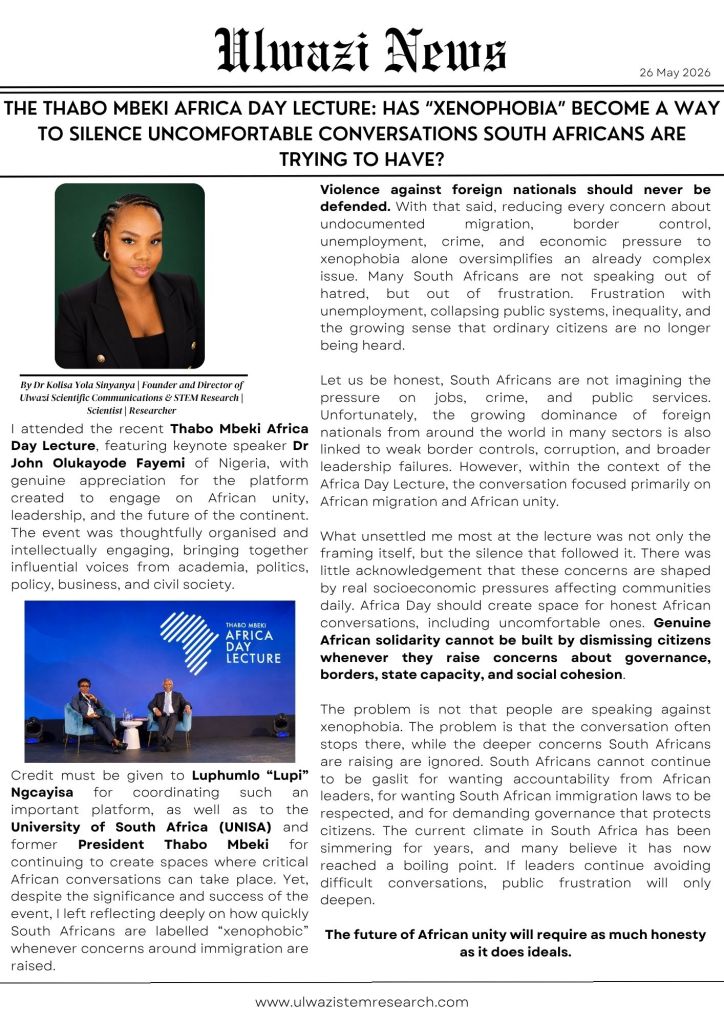
I attended the recent Thabo Mbeki Africa Day Lecture with genuine appreciation for the platform it created around African leadership, unity, and the future of the continent. The event brought together influential voices from academia, politics, policy, business, and civil society at a time when Africa continues to navigate economic pressure, political uncertainty, and growing social tensions. The lecture itself was intellectually engaging and thoughtfully organised. Platforms like these remain important because Africa needs spaces where ideas, leadership, and the continent’s future can be openly discussed. Yet despite appreciating the significance of the event, I left carrying a deep sense of discomfort.
The Discomfort Many South Africans Are Afraid to Voice
As the keynote touched on xenophobia and migration, I found myself thinking less about the lecture itself and more about the growing emotional divide currently unfolding in South Africa. Increasingly, many South Africans feel that the moment concerns around immigration, border management, unemployment, crime, or pressure on public systems are raised, the conversation immediately shifts to accusations of xenophobia.
Violence against foreign nationals should never be defended. That should be said clearly and without ambiguity. But at the same time, many South Africans are not speaking from hatred. They are speaking from exhaustion, frustration, and the feeling that the realities they experience daily are often dismissed or oversimplified. Behind these frustrations lie deeper concerns about weak governance, corruption, inequality, economic pressures, and the growing perception that ordinary citizens are no longer genuinely heard.
African Unity Requires Honest Conversations
As someone who works internationally and whose voice increasingly reaches global platforms, I understand how sensitive conversations around migration and xenophobia can become. I also understand the danger of rhetoric that fuels hatred or violence. But I equally believe that avoiding difficult conversations because they are uncomfortable is not sustainable.
African unity cannot survive only as an ideal discussed in conference halls while ordinary citizens across the continent feel unheard in their own countries. If Pan-Africanism is to remain meaningful, it must create room for honesty alongside solidarity. The concern is not that xenophobia is being challenged, but that the conversation too often ends before addressing the deeper issues many South Africans are raising around governance failures, corruption, economic pressure, unemployment, border management, and growing social instability. We can no longer remain silent and pretend that the current situation is normal. It is neither normal nor sustainable.
South Africa has changed drastically over the years, and ordinary citizens are feeling the impact of those changes daily through rising insecurity, economic hardship, pressure on public systems, and growing social tension. Yet many political and intellectual elites continue to engage with these realities from a distance, often dismissing public frustration rather than confronting the deeper governance failures that have allowed the situation to escalate.
South Africans Want to Be Heard
South Africans cannot continue to be gaslit for wanting accountability from African leaders, for wanting South African laws to be respected, and for demanding governance that protects citizens while still treating foreign nationals with dignity and humanity. Difficult as it may be to say, many African governments must also confront why so many of their citizens increasingly view South Africa as a place of economic survival rather than opportunity within their own countries. Governance failures across the continent cannot be separated from migration realities.
At the same time, the South African government cannot escape accountability for the current situation. A functioning state should be able to manage its immigration systems, enforce its laws fairly and consistently, and maintain public trust without fear or favour. Those of us who travel internationally understand that immigration laws are implemented firmly across the world. South Africans are not asking for anything extraordinary. They are asking for lawful governance, accountability, and a state that functions effectively.
What is unfolding in South Africa is no longer a conversation that can be dismissed or avoided. It reflects deeper cracks in governance, leadership, state capacity, and public trust. If African unity is truly to survive and thrive, then honesty must become part of the conversation too.
Dr Kolisa Yola SInyanya

