I was invited to participate as a panelist at Aviation Indaba 2026, scheduled for 20- 21 August at the Sandton Convention Center in Johannesburg. While the Indaba was ultimately postponed just two days before it was due to begin, the invitation opened an interesting professional conversation for me: what does an ocean scientist have to contribute to aviation?
As it turns out, quite a lot.
I was invited to contribute to the panel Building a Resilient and Sustainable Future for African Aviation, which brought together expertise spanning oceanography, weather and climate services, energy innovation and airport climate resilience. My contribution centred on ocean and environmental intelligence and the opportunities that exist where ocean science, aviation and emerging technologies intersect.
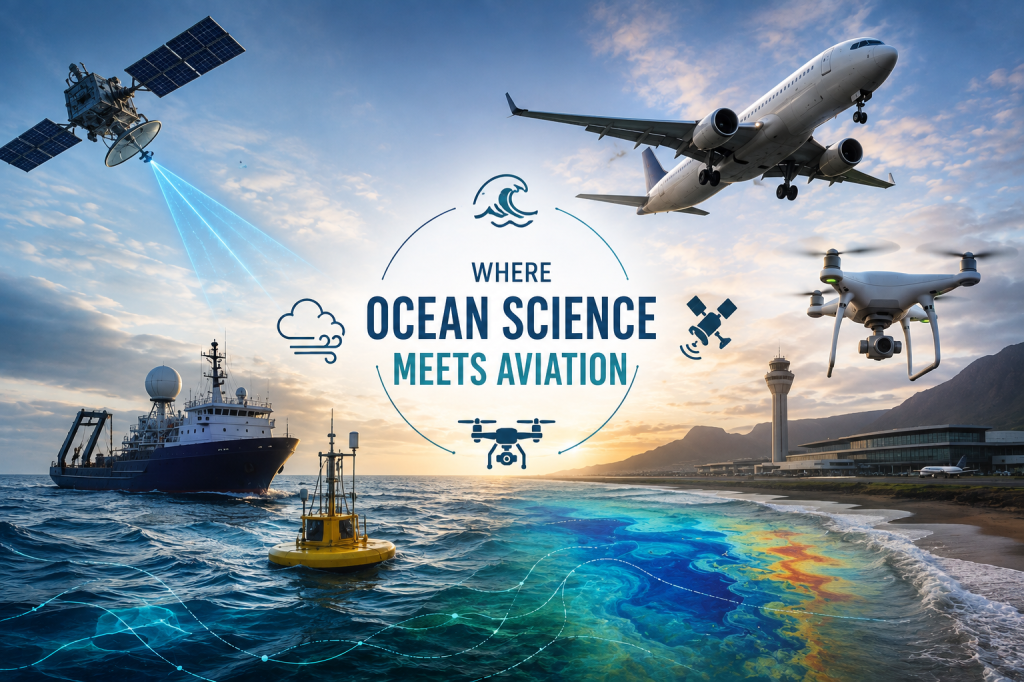
Where Ocean Science Meets Aviation
For someone whose scientific background is in ocean biogeochemistry, aviation may initially appear far removed from my usual work. But environmental systems do not operate in disciplinary boxes. Aviation is influenced by weather and climate, while coastal and island aviation infrastructure is increasingly exposed to sea-level rise, flooding, storms, and other climate-related risks. There are also exciting opportunities for aviation technologies themselves to support ocean science. Drones and other aerial technologies can complement satellites, research vessels and traditional ocean-observation systems by supporting coastal monitoring, environmental surveillance and data collection.
Search and rescue provides an especially practical example of the relationship between ocean and aviation sciences. When someone is lost at sea, knowing their last known position is only the beginning. Ocean currents, waves, and winds influence where that person or vessel may subsequently move. Oceanographic and atmospheric information can therefore help define a search area, while aircraft and drones provide the speed and observational capability required to search it. Similar integration can support disaster response, humanitarian operations, pollution monitoring, and coastal surveillance. This was the perspective I was preparing to bring to Aviation Indaba.
African Science Should Be Part of African Aviation
What particularly interested me about the panel was that it went beyond discussing aircraft. It asked how Africa can harness science, environmental intelligence, energy innovation and emerging technologies to build an aviation sector that is safer, more sustainable and more resilient. One of the questions we were preparing to consider was how Africa can ensure that emerging technologies generate local companies, skills, intellectual property, and jobs rather than simply increasing our dependence on imported technologies.
That question stayed with me.
As a scientist, I have become increasingly interested not only in the knowledge we produce but also in what happens to that knowledge afterward.
How does science move beyond journals and conferences?
How does it influence policy?
How does it become technology?
How does it support industry?
And how does African scientific expertise contribute to African economic development?
These are questions that increasingly connect my work in ocean science, sustainability, science communication, and the ocean economy.
Then the Indaba Was Postponed
On 18 August, the Aviation Indaba 2026 Organising Committee announced that the event would be postponed. In a communication sent to participants, organizers explained that some stakeholders had reconsidered their participation amid migration-related tensions and sensitivities in South Africa. The resulting withdrawals, we were told, affected both stakeholder participation and the resources required to deliver the Indaba at the intended scale.
I was disappointed.
I had prepared for the panel and was looking forward to engaging with professionals whose expertise was very different from mine. Interdisciplinary spaces like this are precisely where unexpected collaborations and ideas often emerge. But the postponement also left me thinking about something larger. If external participation and resources are withdrawn, how resilient are the professional and industrial ecosystems we are building here at home?
South Africa has scientists. It has engineers. It has aviation professionals, universities, regulators, technology developers, and researchers. International collaboration is enormously valuable, and aviation is inherently global. But there is an important distinction between collaboration and dependency. That distinction deserves more attention as Africa seeks to expand its aviation, aerospace, technology, and broader industrial capabilities.
The Conversation Is Not Over
The organisers have indicated that Aviation Indaba 2026 will be rescheduled, and I hope the sustainability conversation continues when the Indaba returns. For me, however, something valuable has already come from the invitation. It reinforced a principle that increasingly shapes how I think about my career: scientists should not confine themselves to spaces labelled specifically for their disciplines.
Ocean science belongs in conversations about climate policy. It belongs in conversations about infrastructure. It belongs in conversations about energy, technology, and economic development.
And, yes, it belongs in conversations about aviation.
The challenges facing Africa will not arrive neatly separated according to our university departments. Neither should the expertise we bring to solving them.

